December 29, 2025

2025 will likely be remembered as a favorable year for U.S. pork producers. Tighter hog supplies, solid export demand, and ample global feed grain availability combined to support strong margins for much of the year. While a government shutdown delayed the release of several key reports, USDA Market News coverage largely continued, allowing cash markets to function with minimal disruption. Early-spring tariff headlines introduced uncertainty, but profitability ultimately proved resilient. Record-high beef retail prices also provided a meaningful tailwind to domestic pork demand. As the industry turns to 2026, producers are once again positioned with an opportunity to protect historically attractive margins.
Market Fundamentals
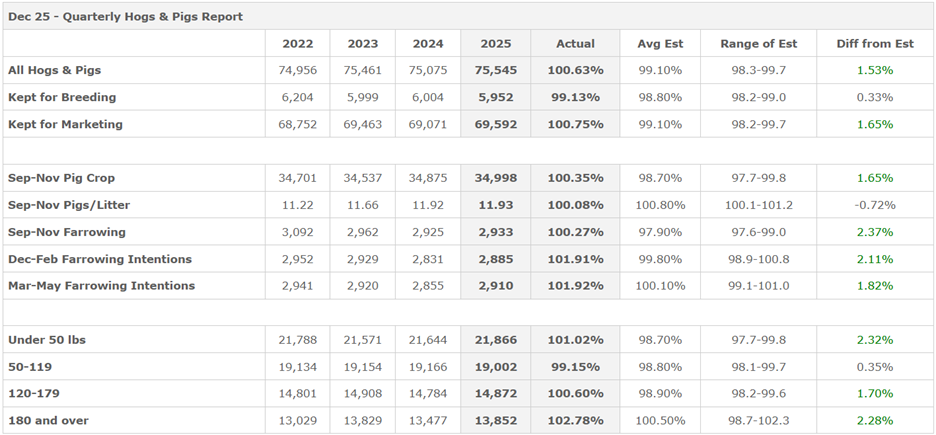
USDA released its quarterly Hogs and Pigs report on December 23, providing updated insight into inventories, farrowings, and farrowing intentions. Relative to pre-report expectations, the data leaned bearish. Total hog inventory on December 1 was estimated at 75.545 million head, up 0.63 percent from a year ago and modestly above the September estimate. Pigs kept for breeding were slightly below year ago levels, as expected. Pigs kept for marketing totaled 69.592 million head, 0.75 percent higher than last year and above the upper end of analysts’ pre-report ranges. The September–November pig crop was record large, supported by a record pigs per litter rate over the same period. Inventory levels in the under 50-pound, 120 to 179-pound, and 180 pounds and over categories all exceeded year-ago levels and came in above the high end of pre-report expectations.
Figure 1. December 2025 Hogs and Pigs Summary
Data Source: USDA
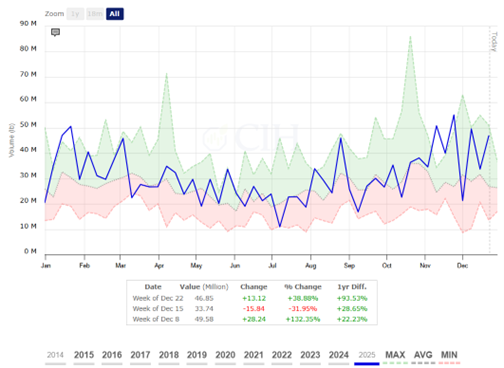
The federal government continues to play catch-up on data releases following the record-long 43-day shutdown this fall. As a result, traditional monthly and weekly export data remain meaningfully lagged. In the interim, an often-overlooked source of information can be found in the LM_PK640 report. Released Monday mornings for the prior week, these data offer a timelier snapshot than the FAS Weekly Export Sales reports, which are published Thursdays, or official export figures that lag by at least five weeks. While the series can be noisy and a single data point does not constitute a trend, recent readings point to improving demand outside of North America. The strong finish to the year has been a welcome development for pork producers.
Figure 2. National Weekly Pork Report FOB Plant – Export Sales
Data Source: USDA
Domestically, tight cattle supplies have been well documented and continue to support elevated beef prices at the consumer level. U.S. beef production is down 4.1 percent year-to-date, while feedlot placements remain 10 to 12 percent below year-ago levels. Despite efforts by the Trump Administration to apply downward pressure on retail beef prices, values have hovered near or above record highs for much of the year. This dynamic has created a clear opportunity for pork to be positioned as a cost-effective protein alternative and has likely provided a tailwind to domestic pork demand. As a share of Choice beef prices, the pork retail complex is at its lowest level on record since the series began in 1970.
Figure 3. Pork Retail Price as Share of Choice Beef

Data Source: USDA
Feed costs remain favorable across much of the country, keeping costs of production in check. South American weather has been largely uneventful to date, with no material concerns at this stage of the growing season. The January 12 WASDE will deliver final crop production estimates for the 2025/26 domestic balance sheet and, absent a surprise, should confirm ample U.S. supplies. While a renewed flare-up in Black Sea tensions has captured recent headlines, grain futures have thus far priced in little in the way of sustained risk premium.
Margin Outlook and Coverage Considerations
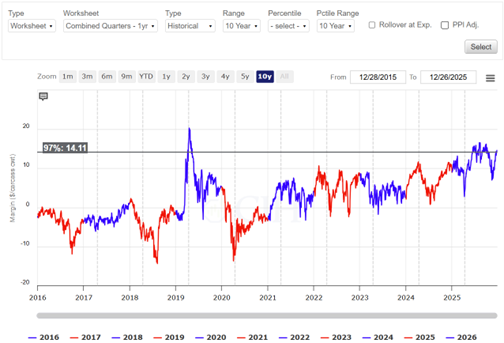
As shown on the far-right side of the graph below, calendar-year 2026 hog margins for this operation (12 months combined) sit near the 97th percentile of historical profitability. Even on an inflation-adjusted basis, the combined four-quarter margin remains above the 89th percentile. The open market margin outlook over the next four quarters is historically attractive. Margin protection strategies will vary by operation, but addressing hog and feed risk concurrently generally makes sense. There is no rule that margins cannot move higher; however, hog margins can, and often do, change quickly. Without eliminating all upside participation, it may be prudent to reduce exposure to lower-margin outcomes.
Figure 4. Rolling 4 Quarters Margin Chart
For producers who believe the market can continue to move higher and are seeking a cost-effective, cash-flow-friendly risk management tool, Livestock Risk Protection (LRP) warrants consideration. A primary use case for LRP is reducing basis risk, which is often most pronounced during the late-December to early-January timeframe.
LRP-Swine settles against the Lean Hog Index (LHI) rather than a specific futures contract. While the CME Group lists eight lean hog futures contracts per calendar year, only seven are actively used, creating gaps of roughly 60 days between expirations—such as mid-December through mid-February. Because LRP settles to the LHI instead of futures prices, it can be particularly effective during these gaps, especially when they coincide with seasonally weak basis levels, as is often the case for hog producers at year-end. More broadly, LRP can meaningfully reduce basis risk for animals priced off the LHI or in markets where price discovery closely tracks the index. Coverage periods that align with this time of year have been used by many of our clients and will remain a focus in the weeks ahead.
The year ahead presents both opportunity and ongoing risk for pork producers. A customized, proactive risk management plan can help navigate uncertainty while capitalizing on favorable market conditions. Contact us to learn more about strategies to take advantage of what the market is offering and take greater control of your bottom line. Best wishes for a productive and prosperous 2026.
Originally published in NHF on 12/29/25